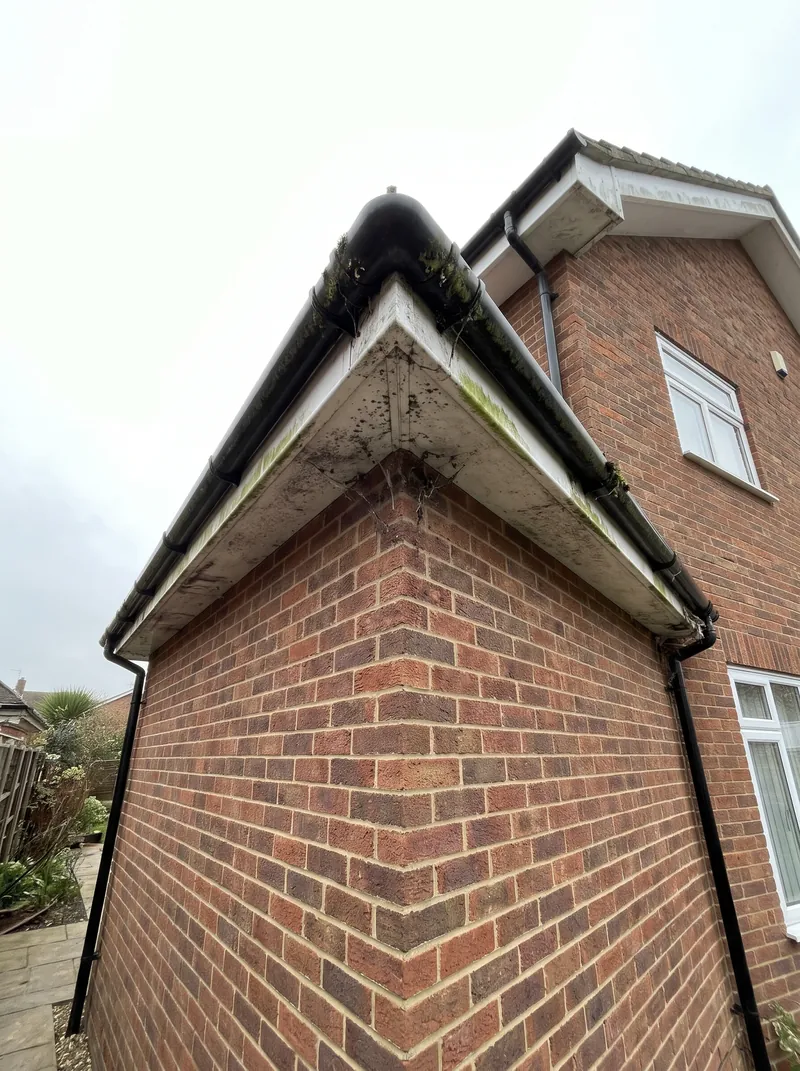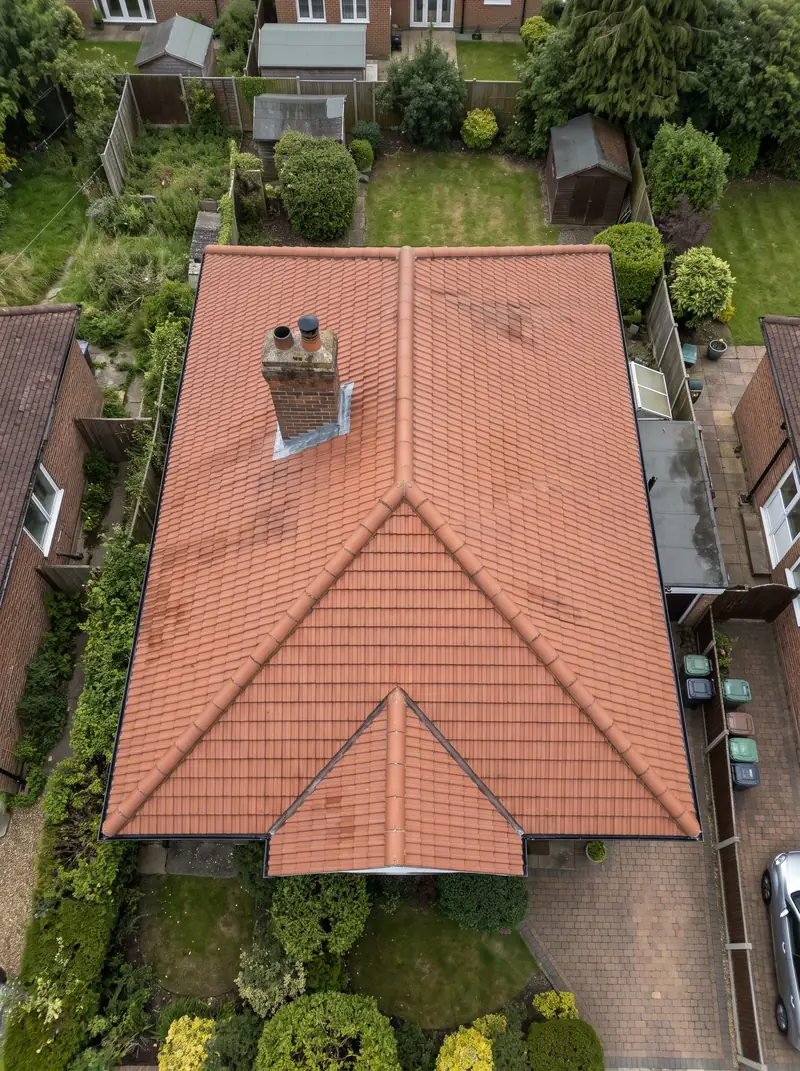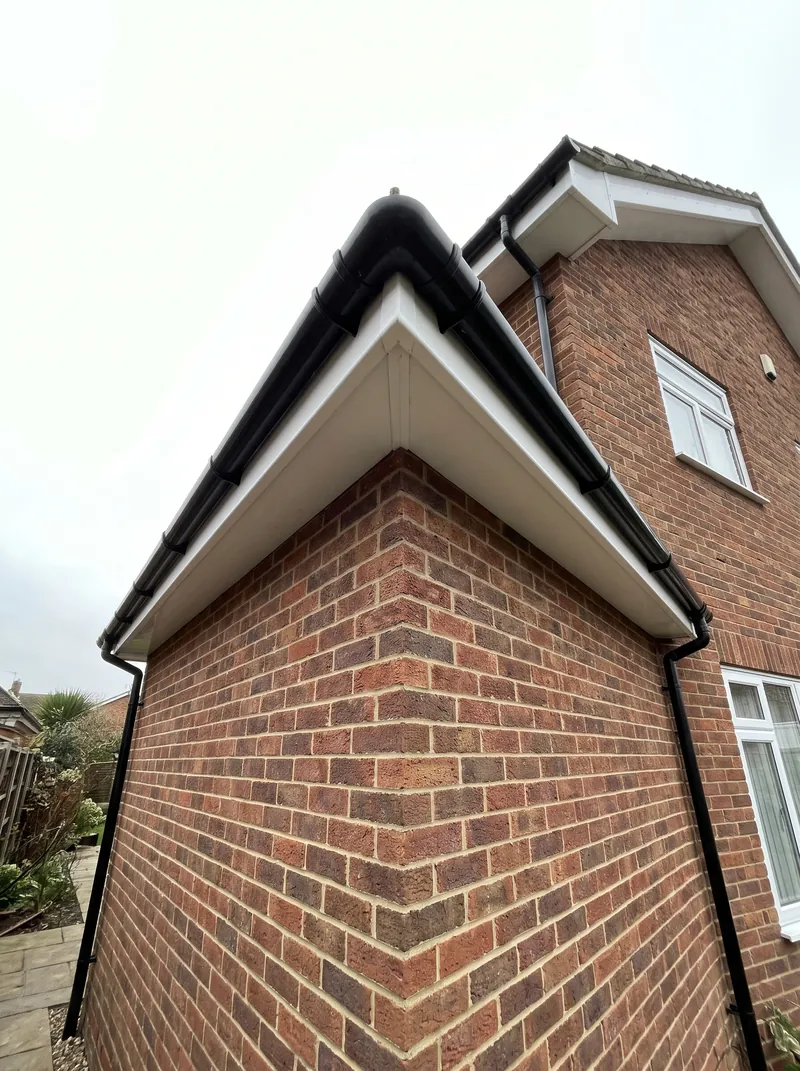
Gutters usually leak at the joints because the rubber seals between sections have hardened, shrunk or cracked with age. Leaks also happen when sections move apart, when brackets drop, or when a blocked gutter holds water against the joints for long periods. Clearing the gutter sometimes stops the drip; often the seal needs replacing.
How are plastic gutters joined?
Plastic gutters come in lengths joined with union brackets. Each union has a rubber seal that the gutter clips into. The seal stops water escaping at the join. Corners, outlets and stop ends have seals too.
Why do the seals fail?
- Age: rubber hardens and cracks after years in sun and frost
- Movement: plastic expands in heat and shrinks in cold, which works the joints loose
- Dirt: silt and grit get between the gutter and the seal
- Weight: a full gutter pulls on the joints
- Ladders: a ladder leant on a gutter can push sections out of the seal
Does a blocked gutter make leaks worse?
Yes. A clear gutter only holds water briefly in a storm. A blocked one holds water against the joints for days. A seal that would cope with a quick flow of water starts to drip. Clearing the gutter sometimes stops a leak, at least for a while.
How can I tell if it’s a leak or an overflow?
A leak drips from one point, usually a joint, corner or outlet. An overflow spills over the front edge along a length. You might see both if the gutter is blocked and the joints are old. The camera shows which it is.
Can a leaking joint be fixed?
Often, yes. Common fixes include:
- Cleaning the joint and refitting the gutter into the seal
- Replacing the union bracket with a new one
- Using a gutter sealant as a short-term fix
- Adjusting the brackets so the gutter sits properly
These are jobs for a gutter fitter or roofer. We clear and check gutters, and if we see a leaking joint we show you on the camera so you know what to ask for.
What about cast-iron gutters?
Cast-iron gutters are bolted together with putty or sealant in the joints. Over time the putty dries out and the bolts rust. Leaks from cast-iron joints need the joint taking apart, cleaning and resealing. Cast iron is heavy, so it’s a job for a specialist.
Is a leaking joint urgent?
Not usually an emergency, but water dripping onto a wall or path for months causes the same problems as an overflow: wet brickwork, staining and green growth. Get it looked at.
Can leaks come from the outlet?
Yes. The outlet, where the gutter meets the downpipe, has a seal too. Leaks here often look like water running down the outside of the downpipe. It’s worth checking the outlet isn’t blocked first.
Why does my gutter leak only in heavy rain?
A slightly worn seal may hold in light rain but not when the gutter is full. Or the gutter may be overflowing at a joint because it’s blocked downstream. Clearing the gutter and testing it with water usually shows which.
What should I do next?
Get the gutters cleared and checked. If the leak stops, it was the blockage. If it doesn’t, the camera photos show the joint so a fitter can quote. Gutter cleaning includes a water test.
Which joints leak first?
Corners and outlets, usually. Corners take water from two directions and often sit where a roof valley sends the heaviest flow. Outlets have water standing in them whenever the downpipe is slow. Joints on the sunny side of the house age faster too, because heat and sun harden the rubber.
Can I fix a leaking joint myself?
On a bungalow, some people do: unclip the gutter from the union, clean the seal and the gutter end, and clip it back in, or fit a new union. It means working at the gutter from a ladder, so take care, and never lean the ladder on the gutter itself. On a two-storey house, or if the gutter is old and brittle, it’s better left to a fitter.
Will sealant fix it?
Gutter sealant can stop a drip for a while, especially on cast iron. On plastic, sealant often fails because the gutter keeps expanding and shrinking with the temperature, which breaks the seal again. A new union bracket is usually the better fix.
Does a leaking gutter need replacing?
Not usually. Most leaks are at the joints, and joints can be renewed without replacing the whole gutter. If the gutter itself is cracked, brittle or badly sagged, replacement may make sense, and that’s a conversation to have with a roofline company. We can give you camera photos to take to them.
Why does water run behind my gutter?
That’s different from a joint leak. Water running down the back of the fascia often means there’s a gap between the roof edge and the gutter, or the felt at the eaves has perished, so water drips behind the gutter instead of into it. The camera can usually show it, and it’s a roofer’s job to fix.
How do I spot a leaking joint from the ground?
Look along the gutter during rain. A leak shows as a steady drip or a thin stream from one point, usually under a joint, corner or outlet, while the rest of the gutter looks fine. On a dry day, look for a green spot or a dark stain on the wall or path directly underneath the joint. That stain is often the first sign, long before anyone sees the drip.